Project Team

design and prototyping

UX/UI design

Every year since 2009, the MFIC’s 40 member companies, which generate around 21% of Montenegro’s GDP and employ approximately 6,000 people, assess the country’s business environment. Their answers become the White Book – the publication that shapes the Council’s policy recommendations to the Government and other key decision-makers. Until recently, collecting those answers meant 40 email threads, 40 versions of a Word document, and a team retyping everything into Excel before the analysis could even begin.
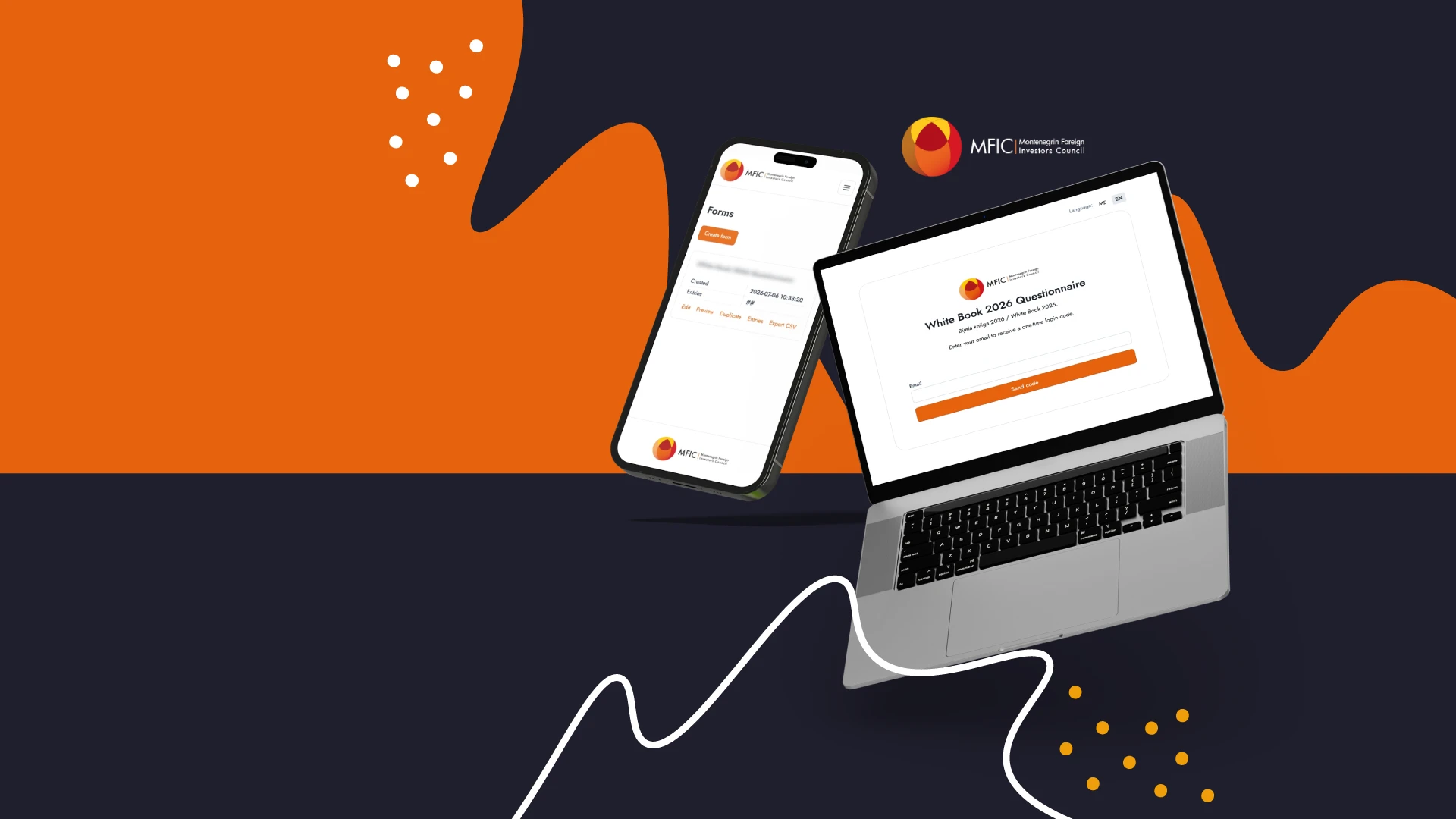
Today, MFIC runs the entire cycle from one system that shows who has submitted what, what is waiting for validation, and what is ready for analysis.
MFIC represents the voice of foreign investors before decision-makers in Montenegro, and the White Book is its central instrument. Member companies’ assessments feed the MFIC indices, which track how the business and investment environment shifts from year to year and form the basis for concrete policy recommendations.
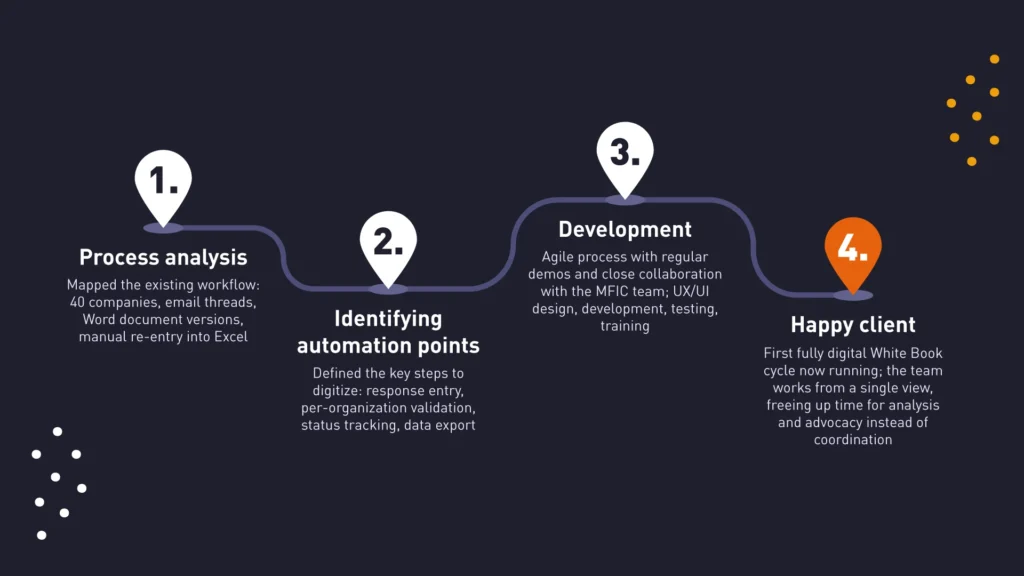
That makes the quality of the data collection process a direct input into the quality of the recommendations. When MFIC reached out to us, that process ran almost entirely on Word documents and email.
The process worked, but it worked because the MFIC team absorbed any weaknesses. Every answer was checked and transferred by hand, every year’s dataset reconciled against the last, and every company’s status tracked through individual email follow-up. The method held; the cost was the team’s time and the absence of any system-level view of where the process stood.
The collaboration with Alicorn met all of the expectations of the Montenegrin Foreign Investors’ Council team. From the very beginning, they showed a clear understanding of our needs, mapped out the existing process in detail, and proposed solutions that improved its functionality and user experience. The final solution is intuitive and easy to use for both administrators and end users. Quality training and continuous support also made its adoption fast and successful. Digitalizing the questionnaire significantly improved the quality and speed of data collection, processing, and report generation.
MFIC
Challenge
Collecting data for the White Book is a process that involves 40 different organizations, each with its own internal workflow, departments, and approval procedures. Word documents and email had carried that process for years, but they were never built to hold it permanently.
Coordination consumed the calendar: Every company has its own internal priorities and reporting cycles, so gathering 40 responses meant a sustained cycle of reminders and follow-ups. The work always got done; it simply left less room than it should have for the part that matters most, such as analysis, recommendations, and advocacy.
Questionnaire status could only be established manually. The MFIC team had no way of knowing who had started filling in the questionnaire, who had finished, or whether parts of it had been skipped. The only way to check was to manually review the documents as they arrived.
Multi-department input had no shared workspace. In larger companies, where different departments fill in different sections of the questionnaire, the process often meant printing the form, filling in multiple versions by hand, and later retyping everything into a single file. It worked, but the effort depended on the member company.
Costly data processing. Once completed questionnaires finally arrived, the MFIC team manually transferred the data into Excel and prepared it for analysis, a step that ate into the time that should have gone toward analysis, formulating recommendations, and advocating for change.
Our Solution
We built MFIC a single platform for the entire White Book cycle, from the moment a questionnaire opens to the moment the dataset is ready for analysis.
Instead of 40 documents moving through 40+ inboxes, every member company works inside one structured, bilingual questionnaire (Montenegrin and English), and the MFIC team runs the whole cycle from a single view.
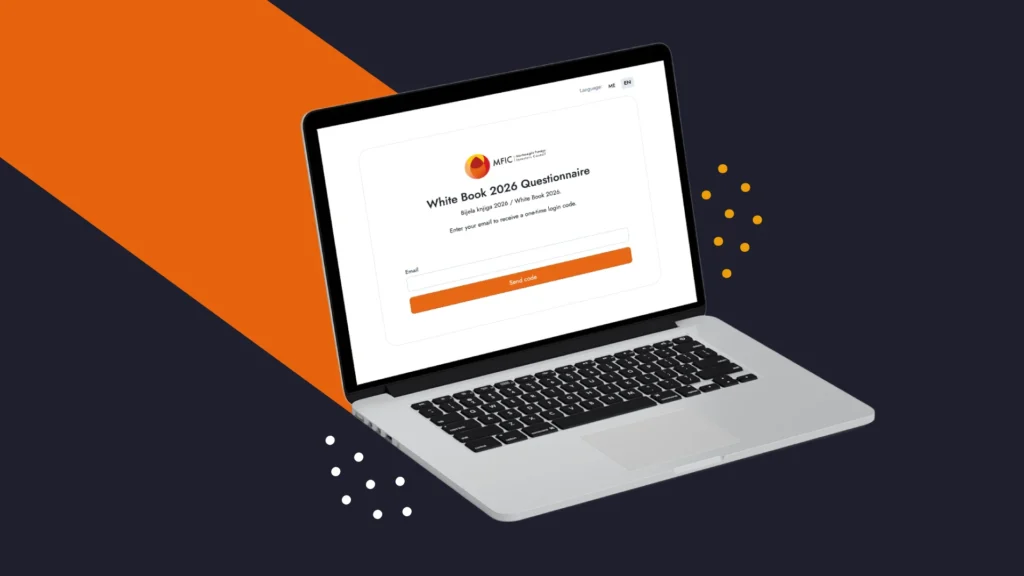
One questionnaire, filled in where the work happens. Each company works directly in the platform instead of in a circulated file. Every form has its own URL, and access is confirmed by a verification code the admin can always re-issue, so no one is locked out by a lost email. Answers save as drafts, so the assessment can be completed over several sittings; in larger companies, different editors from the same organization can pick up where a colleague left off.
Validation mirrors each organization’s own approval. Once an editor finalizes their answers, the entry moves to the organization’s validators – up to two, or straight to completion if it uses none – who approve it or return it for revision. Every transition triggers an automatic notification to the right person, so the process moves without manual reminders. Nothing counts as data until it has passed this step, and once finalized, a questionnaire is locked and essentially becomes data.
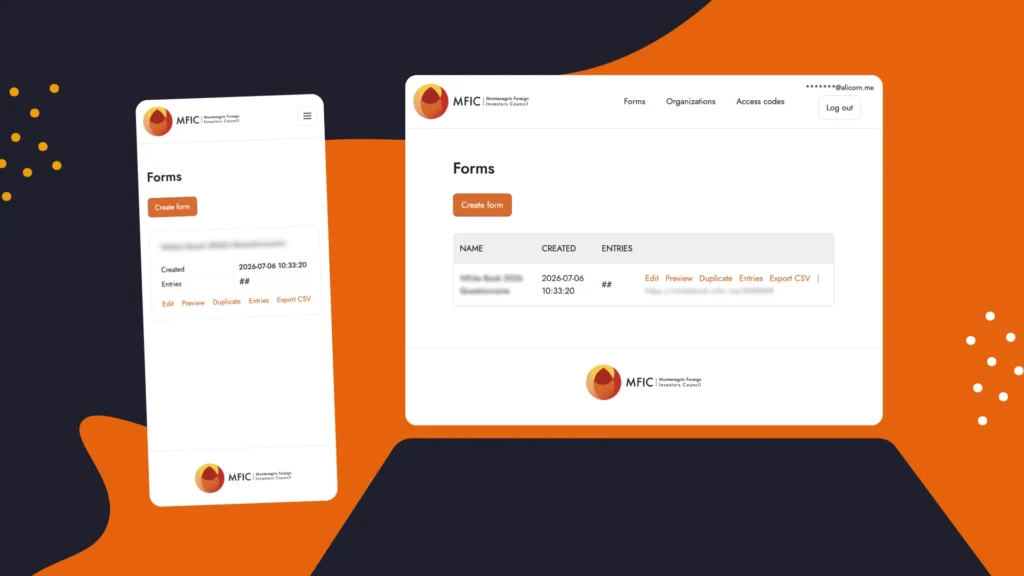
Status is visible at a glance. The MFIC team can see who has started, who has submitted, what’s waiting for validation, and what’s ready in real time.
Data arrives ready for analysis, and comparable across years. Every answer is captured in set structure from the start, so export to Excel replaces the manual re-entry that used to open each cycle. And because the questionnaire is defined once and applied identically to every organization, each year’s data lines up with the last by design.
A project like this transforms a process rather than digitizing a document, and a process only reveals its real requirements once people start using the system. Working in an agile way – regular presentations of completed increments, close client involvement throughout – we surfaced and built in capabilities a written brief could never have anticipated, among them administrative management of organizations and the locking of completed questionnaires. The MFIC team’s deep knowledge of their own process was decisive: it let us anticipate the edge cases that break systems in practice, such as a changed or removed organization email, so the submission process never gets stuck
From Inbox Chaos to a System That Remembers Everything for the Team
The White Book’s first fully digital cycle is running now, on the platform.
The MFIC team runs it from a single view. They open a cycle, see exactly where every organization stands, and act on what needs attention, directing a process that used to be held together across dozens of separate conversations.
That shift changes what the team spends its expertise on. The coordination that once absorbed their attention is now carried by the system, so their time goes to the work the White Book exists to produce: analysis, recommendations, and advocacy before decision-makers.
The member companies feel it too. Completing the assessment is a single, clear task, done in Montenegrin or English, at their own pace, with internal approval handled inside the system, from first draft to final validation.
Projects like this are the ones we’re proudest to work on. The MFIC team knows its process inside out, and our job was to give that expertise a system worthy of it: to take work they had always done well and make it lighter to carry. Helping a team of this calibre shape a tool around the way they actually work has been a genuine privilege, and we’re glad the White Book’s next chapter will be written on it.